
The Hidden Factors Affecting Egg Quality:
Beyond Age and Hormones

Why Many High-Performing Women Experience Fertility Stress Earlier Then Expected
When women think about fertility, one factor dominates the conversation:
Age.
While age is biologically relevant, it is not the only determinant of reproductive health—and for many women today, it is not even the most important one.
An increasing number of women in their 20s and early 30s are experiencing signs of reduced reproductive resilience, including hormonal imbalance, irregular cycles, inflammation, fatigue, and difficulty conceiving when they decide to try.
This challenges the traditional narrative that fertility concerns begin later in life.
Instead, we are seeing a different pattern emerge:
Fertility is being influenced less by chronological age and more by biological environment.
And for many high-performing women, that environment is shaped by stress, pace, and lifestyle long before pregnancy is even considered.
IN THIS ARTICLE
- What egg quality really means in modern reproductive health
- Why age alone does not explain fertility challenges
- Mitochondria and cellular energy production
- Oxidative stress and inflammation
- Sleep and nervous system load
- Environmental and lifestyle exposures
- Metabolic resilience and reproductive function
- What women in their 20s–30s can do now to support fertility
Egg Quality Is Not Just About Age
Egg quality refers to the functional health of an egg—its ability to mature, be fertilized, and support early embryonic development.
While age influences egg quantity and quality over time, eggs are also highly sensitive to the biological environment in which they mature.
EGGS ARE INFLUENCE BY:
➡ Stress Levels
➡ Nutrient availability
➡ Inflammation
➡ Metabolic function
➡ Sleep quality
➡ Environmental exposures
➡ Nervous system regulation
Eggs take approximately 3 months to mature before ovulation.
So the conditions in your body today directly influence the reproductive environment
of the next cycle.
This is where modern fertility science is shifting its focus—from age-centered models to
biology-centered models of reproductive health.
Why High-Performing Women Need a Different Fertility Conversation
Many women in their 20s and 30s appear outwardly healthy while living under significant physiological load.
This includes:
- High responsibility careers
- Chronic cognitive stress
- Long work hours
- Digital overstimulation
- Sleep disruption
- Under-recovery
- Constant nervous system activation
The body does not distinguish between “productive stress” and “harmful stress.”
From a biological perspective, both activate the same adaptive systems.
Over time, this can influence:
- Hormonal signaling
- Energy production
- Inflammation levels
- Metabolic regulation
- Reproductive prioritization
This does not mean stress “causes infertility.”
It means the body continuously adapts to its environment—and reproduction is highly sensitive to that environment.
Fertility Reflects Overall Biological Health
Egg quality is not determined by one factor.
It reflects the integration of multiple systems, including:
- Nervous system regulation
- Mitochondrial energy production
- Hormonal signaling
- Metabolic balance
- Immune function
- Detoxification capacity
- Sleep and circadian rhythm stability
When these systems are supported, reproductive resilience improves.
When they are under strain, reproductive function is often one of the first areas to reflect that imbalance.
Mitochondria: The Energy Engine of Reproductive Health

Mitochondria are responsible for producing cellular energy.
Egg cells contain an exceptionally high number of mitochondria because early embryo development is energy-intensive.
Healthy mitochondrial function supports:
- Cellular division
- DNA stability
- Embryo development
- Ovarian function
- Overall reproductive resilience
Mitochondria are sensitive to:
- Chronic stress
- Poor sleep
- Nutrient depletion
- Blood sugar instability
- Inflammation
- Environmental toxins
This is one of the reasons lifestyle factors have such a strong influence on fertility outcomes—even in younger women.
Oxidative Stress and Cellular Balance

Oxidative stress occurs when the body produces more reactive molecules than it can neutralize.
At low levels, this is normal.
At chronic levels, it can contribute to:
- Cellular damage
- Inflammation
- Mitochondrial strain
- Reduced reproductive efficiency
The body relies on antioxidant systems supported by:
- Nutrient-dense foods
- Sleep quality
- Stress regulation
- Metabolic stability
The goal is not to eliminate oxidative stress—it is to maintain balance.
Sleep: A Non-Negotiable Fertility Regulator

Sleep is one of the most powerful regulators of hormonal and metabolic health.
During sleep, the body:
- Regulates cortisol rhythms
- Repairs cellular systems
- Balances glucose metabolism
- Supports immune function
- Restores nervous system balance
Chronic sleep disruption can subtly affect reproductive signaling long before clinical symptoms appear.
For many high-performing women, sleep is the most under-supported fertility factor.
Environmental Load and Modern Exposure

Modern environments expose women to a wide range of compounds, including:
- Endocrine-disrupting chemicals
- Plastics and microplastics
- Pesticide residues
- Air pollutants
- Household chemicals
The body has natural detoxification systems, but these systems operate under a cumulative load.
Reducing unnecessary exposure and supporting detoxification pathways can help create a more stable internal environment for reproductive health.
Metabolic Health: The Foundation of Hormonal Stability

Metabolic health refers to how efficiently the body produces and uses energy.
Key markers include:
- Blood sugar stability
- Insulin sensitivity
- Inflammatory balance
- Energy production efficiency
Metabolic imbalance can influence:
- Ovulation regularity
- Hormone signaling
- Egg development environment
- Reproductive resilience
This is one of the most overlooked contributors to fertility challenges in younger women.
The Nervous System Is the Missing Layer

One of the most important—but least discussed—factors in reproductive health is the nervous system.
The body prioritizes survival over reproduction.
When the nervous system is chronically activated, the body may:
- Downshift reproductive signaling
- Alter hormone balance
- Affect sleep and recovery
- Increase inflammatory signaling
- Reduce long-term reproductive prioritization
This is especially relevant for high-achieving women who operate in sustained performance mode.
Supporting nervous system regulation is not a “wellness trend.”
It is a foundational biological requirement for reproductive resilience.
What You Can Do Now
(Without Overcomplicating It)
You do not need a perfect routine to support reproductive health.
Focus on consistency in the basics:
- Prioritize restorative sleep
- Stabilize blood sugar through regular meals
- Reduce chronic overstimulation where possible
- Support daily nervous system regulation
- Increase nutrient-dense whole foods
- Move your body regularly
- Reduce unnecessary environmental exposures
Small shifts, applied consistently, create meaningful biological change over time.
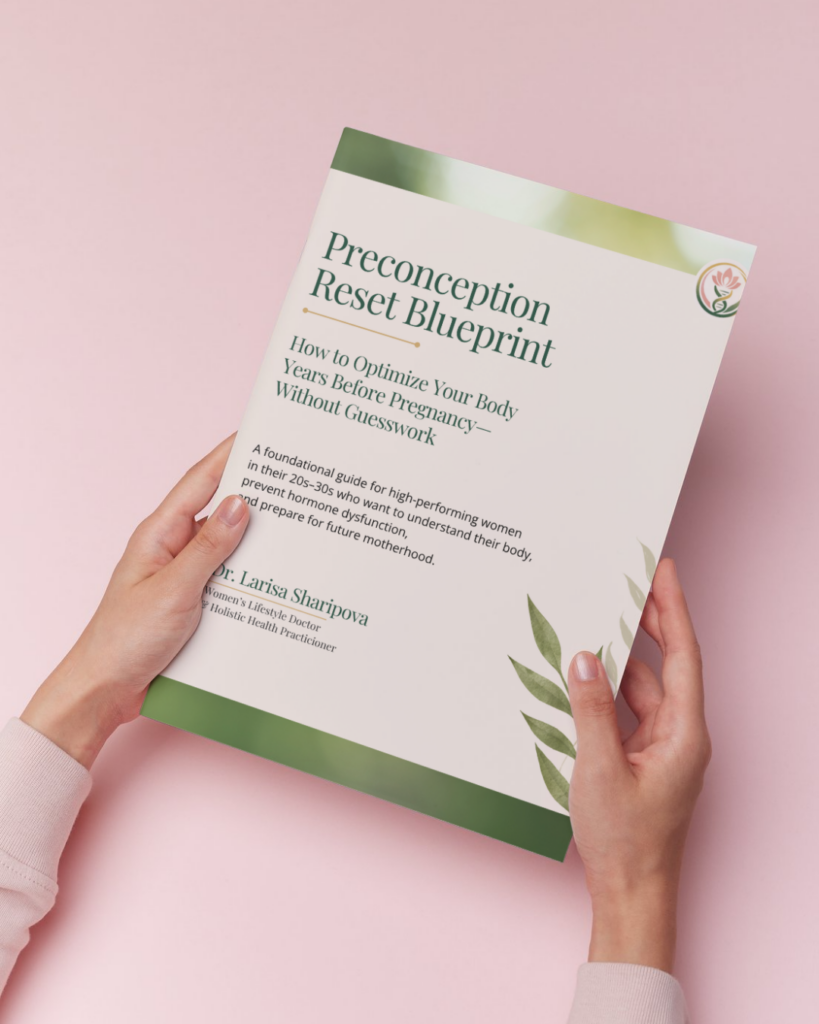
Download the Preconception Reset Blueprint
If you are planning for pregnancy in the future—or simply want to understand your body better—this guide will help you build a strong foundation.
Download the Preconception Reset Blueprint
Inside you will learn:
✓ The key pillars of preconception health
✓ The most common overlooked fertility factors
✓ Simple steps to support reproductive resilience
✓ How to begin optimizing your biology today
Final Thoughts
Egg quality is not determined by age alone.
It reflects the cumulative effect of your biology, lifestyle, environment, and nervous system state.
For many women in their 20s and 30s, fertility challenges are not a sign of “late timing,” but a reflection of modern physiological demands.
The encouraging truth is this:
Biology is responsive.
When the body is supported, it adapts.
And when you begin optimizing before conception, you are not just preparing for pregnancy—you are strengthening the foundation of long-term reproductive health.
Explore Personalized Support
For women seeking deeper, individualized guidance, the Preconception Intelligence™ framework integrates functional genomics, metabolic health, and nervous system regulation to support reproductive optimization before pregnancy.
Continue Your Learning
Next Article
Nervous System Regulation and Fertility:
The Missing Piece of Preconception Health
Learn how stress physiology directly influences hormonal balance, reproductive function, and long-term fertility resilience.
Scientific References
- American Society for Reproductive Medicine (ASRM). Ovarian reserve testing and Optimizing natural fertility: lifestyle and environmental factors. Fertility and Sterility, 2017–2020.
- Broekmans FJ, Soules MR, Fauser BC. Ovarian aging: mechanisms and clinical consequences. Endocrine Reviews, 2009.
- Agarwal A, et al. Oxidative stress and female reproduction. Reproductive Biology and Endocrinology, 2012.
- Sies H. Oxidative stress in redox biology. Redox Biology, 2015.
- Finkel T, Holbrook NJ. Oxidants and aging. Nature, 2000.
- May-Panloup P, et al. Mitochondria and female infertility. Human Reproduction Update, 2016.
- Seli E. Mitochondrial function in oocyte and embryo development. Current Opinion in Obstetrics and Gynecology, 2019.
- World Health Organization (WHO). Infertility prevalence estimates (1990–2021). 2023.
- Diamanti-Kandarakis E, et al. Endocrine-disrupting chemicals. Endocrine Reviews, 2009.
- Bergman Å, et al. (WHO/UNEP). State of the Science of Endocrine Disrupting Chemicals. 2013.
- Gaskins AJ, Chavarro JE. Diet and fertility: evidence review. Fertility and Sterility, 2018.
- Chavarro JE, et al. Dietary factors and fertility outcomes. American Journal of Obstetrics and Gynecology, 2007.
- Dunaif A. Insulin resistance and reproductive dysfunction. Endocrine Reviews, 1997.
- Nepomnaschy PA, et al. Stress hormones and reproductive function. PNAS, 2006.
- Rooney KL, Domar AD. Stress and fertility outcomes. Seminars in Reproductive Medicine, 2018.
- Schisterman EF, et al. Sleep patterns and fecundability. Fertility and Sterility, 2014.
- National Sleep Foundation. Sleep and health consensus recommendations.