
Conscious Preparation for Motherhood:
Why Emotional Health Matters Before Pregnancy

Preparing for Pregnancy Is About More Than Your Body
When women begin thinking about pregnancy, most of the conversation centers on physical health.
 Nutrition.
Supplements.
Hormones.
Exercise.
Lab testing.
While these factors are important, they are only part of the preparation process.
Pregnancy is not simply a biological event.
It is the beginning of a profound transition—one that affects identity, relationships, priorities, emotions, and daily life.
Yet many women spend years preparing academically and professionally for their careers while receiving little guidance on how to prepare for motherhood itself.
This is where conscious preparation becomes valuable.
Just as we can support the body before pregnancy, we can also create space to prepare emotionally, mentally, and intentionally for the journey ahead.
In This Article
- What conscious preparation for motherhood means
- Why emotional health matters before pregnancy
- The connection between stress, self-awareness, and resilience
- How beliefs about motherhood influence experience
- Relationships and support systems
- Identity shifts and life transitions
- Creating alignment before conception
- Practical ways to prepare emotionally
Motherhood Begins Before Pregnancy
Many women think of motherhood as something that begins after a baby arrives.
In reality, motherhood often begins much earlier.
It begins with the decisions, intentions, habits, and awareness that shape the environment in which a future child may grow.
Preparing consciously means asking questions such as:
- What kind of mother do I want to become?
- How do I care for myself during periods of stress?
- What values do I want to pass to my children?
- What patterns do I want to continue?
- What patterns do I want to change?
These questions have no perfect answers.
But they create awareness, and awareness often becomes the foundation for growth.
Emotional Health Is Part of Preconception Health
For many women, emotional wellbeing is treated as separate from physical health.
In reality, the two are deeply interconnected.
Emotional health influences:
- Stress resilience
- Sleep quality
- Nervous system regulation
- Relationships
- Self-care behaviors
- Overall wellbeing
Preparing emotionally does not mean eliminating anxiety or uncertainty.
It means developing the capacity to navigate challenges with greater awareness and resilience.
The High-Achieving Woman's Challenge
Many successful women are accustomed to setting goals, solving problems, and performing at a high level.
These strengths serve them well professionally.
Motherhood, however, often introduces experiences that cannot be fully controlled, optimized, or planned.
For women who are used to measuring success through achievement, this transition can feel surprisingly challenging.
Questions may arise such as:
- Will I still recognize myself?
- How will motherhood affect my career?
- Can I balance both?
- What if things do not go according to plan?
- Am I ready?
These questions are normal.
In fact, asking them often reflects thoughtful preparation rather than uncertainty.
Understanding the Transition of Identity
One of the most significant aspects of motherhood is the shift in identity.
Even before conception, many women begin re-evaluating:
- Priorities
- Relationships
- Career goals
- Personal values
- Lifestyle choices
- Definitions of success
This process is not a sign that something is wrong.
It is often a natural part of preparing for a new chapter.
Giving yourself permission to explore these changes before pregnancy can make the transition feel more intentional and less overwhelming.
Relationships Matter
Humans are not designed to navigate major life transitions alone.
The quality of your support system can influence your experience before, during, and after pregnancy.
Consider reflecting on:
- Communication with your partner
- Family dynamics
- Friendships
- Community support
- Professional support when needed
Strong support networks contribute to resilience, emotional wellbeing, and long-term health.
The Stories We Carry About Motherhood
Every woman develops beliefs about motherhood through her own experiences, family history, culture, and observations.
Some beliefs may be empowering.
Others may create fear, pressure, or unrealistic expectations.
Examples include:
- “I have to do everything perfectly.”
- “Motherhood means sacrificing myself.”
- “I should be able to handle everything alone.”
- “If I struggle, I’m failing.”
Bringing awareness to these beliefs creates an opportunity to replace them with healthier and more supportive perspectives.
Perfection Is Not the Goal
There is no perfect mother. There is no perfect pregnancy. There is no perfect preparation process.
What matters is developing flexibility, self-compassion, and resilience.
These qualities often support wellbeing far more effectively than perfectionism ever could.
Conscious Preparation and Nervous System Health

The emotional aspects of preparation are not separate from biology. They influence it.
When women cultivate:
- Self-awareness
- Emotional regulation
- Healthy boundaries
- Meaningful relationships
- Recovery practices
They often support nervous system resilience as well. This is one reason emotional preparation is included within the Preconception Intelligence™ framework.
The goal is not only to optimize the body.
The goal is to create conditions that support the whole person.
Questions for Reflection
As you prepare for a future pregnancy, consider journaling about the following:
➡ What does motherhood mean to me?
➡ What values do I hope to pass on?
➡ What parts of my life feel aligned?
➡ Where do I need more support?
➡ What habits support my wellbeing?
➡ What am I ready to release?
There are no right answers.
The purpose is awareness.
The Preconception Reset Blueprint
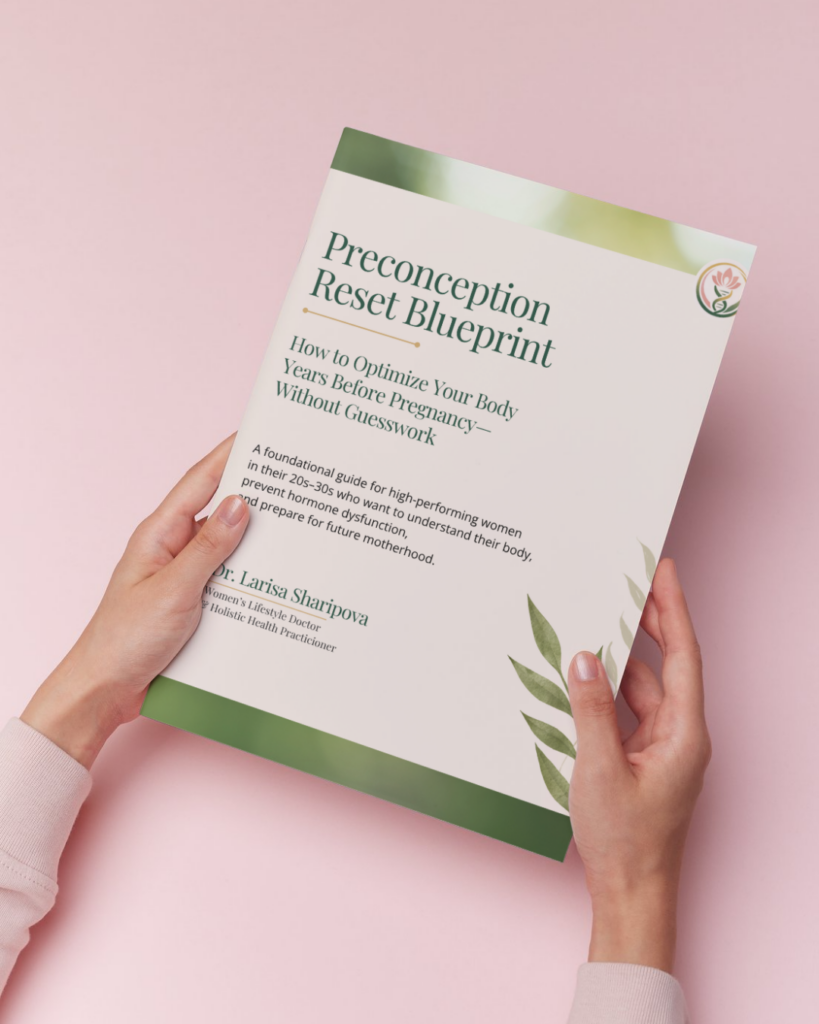
Download the Preconception Reset Blueprint
Preparing for pregnancy involves more than physical health.
The strongest foundation includes biological, emotional, and lifestyle preparation.
Inside you’ll discover:
✓ The five pillars of preconception health
✓ Common overlooked fertility factors
✓ Nervous system and lifestyle strategies
✓ Practical steps to support your future health and pregnancy
Preparing for the Next Generation Begins with You
The future health of a child is influenced by far more than genetics.
It is shaped by the environment, habits, resilience, and wellbeing of the parents who welcome that child into the world.
This is what makes preconception health so powerful.
It is not simply about getting pregnant.
It is about creating the healthiest possible foundation for yourself and for future generations.
Final Thoughts
Preparing for motherhood is not a checklist.
It is a process of becoming.
A process of strengthening your body, understanding your biology, clarifying your values, and creating greater alignment in your life.
The goal is not perfection.
The goal is intention.
Because the healthiest pregnancies often begin long before conception—with a woman who chooses to prepare thoughtfully for the journey ahead.
Ready for a Personalized Approach?
The Preconception Intelligence™ framework combines functional genomics, nervous system regulation, metabolic health, environmental wellness, and conscious preparation for motherhood to help women prepare intentionally for pregnancy.
Continue Your Learning
Start Here:
Preparing for Pregnancy Starts Long Before Conception
Learn why the preconception window is one of the most important opportunities to influence fertility, pregnancy outcomes, and future health.
Scientific References
- Raphael-Leff J. Psychological Processes of Childbearing. Chapman & Hall. 2005.
- Nelson SK, Kushlev K, English T, Dunn EW, Lyubomirsky S. In Defense of Parenthood: Children Are Associated with More Joy Than Misery. Psychological Science. 2013.
- Slade A, Cohen LJ, Sadler LS, Miller M. The Psychology and Psychopathology of Pregnancy. Handbook of Infant Mental Health. 2009.
- Dunkel Schetter C. Psychological Science on Pregnancy: Stress Processes, Biopsychosocial Models, and Emerging Research Issues. Annual Review of Psychology. 2011.
- Chin K, Daiches A, Hall P. A Qualitative Exploration of First-Time Mothers’ Experiences of Becoming a Mother.Community Practitioner. 2011.
- Stern DN. The Motherhood Constellation. Basic Books. 1995.
- Matvienko-Sikar K, Murphy G, Murphy L. The Role of Social Support in Pregnancy and Early Parenthood. Health Psychology Open. 2018.